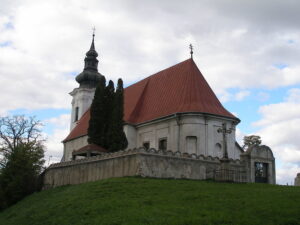
At the end of the 13th century, the inhabitants of Solivar were given permission to start building a church on the right bank of the Torysa River. However, some historians have opposed this claim. In any case, in 1413 Juraj Soós de Soóvar had a church built, part of which still stands today. Only the nave, which has all the features of the original church, remains to this day. gothic buildings. The vault is built on four stone pillars.
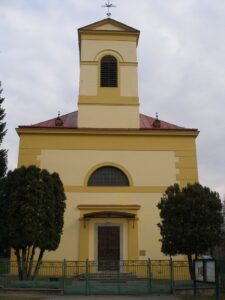
The turbulent revolutionary years and the plague in the 16th century did not bypass the Solivar church either. After the appointment of a parish priest, the question of the parish church took on different dimensions (until then, the parish church was the Church of St. Stephen of Hungary in Hrádek). When in 1751 the parish priest Ján Kelner and the chaplain moved to a new parish building built between Solivar and the Salt Mine, the question of a new parish church had to be solved, because there was no other suitable church in the parish except the Soós church. The reasons for its reconstruction were recognized by the superiors and they pointed out 1200 forints for its repair. The rest of the costs were paid by Count Anton Grassalchovich. This is how the present Holy Trinity Parish Church was built.
The church was restored in 1900. It was enlarged on the eastern side by the sanctuary and on the western side by the vestibule. A sacristy and a new entrance door were added. It follows from the above that the church is originally Gothic, but it was built gradually and therefore contains other elements.
It is a three-nave structure, with the side aisles separated from the central aisle by four piers. Above the arch in the main nave is a mural of the Holy Trinity with the Virgin Mary. In the optical centre of the sanctuary is the main altar, which is no longer original. In the side aisles there were also altars purchased by parish priest F. Fabian in the 1960s. In the presbytery there was rare rococo pulpit from the middle of the 18th century of unusual shapes. However, it was removed as part of the post-Conciliar liturgical reform.
Exterior architecture The church is characterized by supporting pillars in the nave and presbytery. The tower was initially wooden, only later, at the end of the 18th century, was the new baroque one. In the tower there were two bells consecrated by Bishop K. Esztherházy of Jäger around 1775. Neither of them is in the tower nowadays. At the moment there are three bells in the tower, only two of which are electrically powered.
Source : www.solivar.fara.sk
Cover photo: Wikipedia - author. Mgr. Jozef Kotulič - Own work, CC BY-SA 3.0, https://lnk.sk/ijwT