

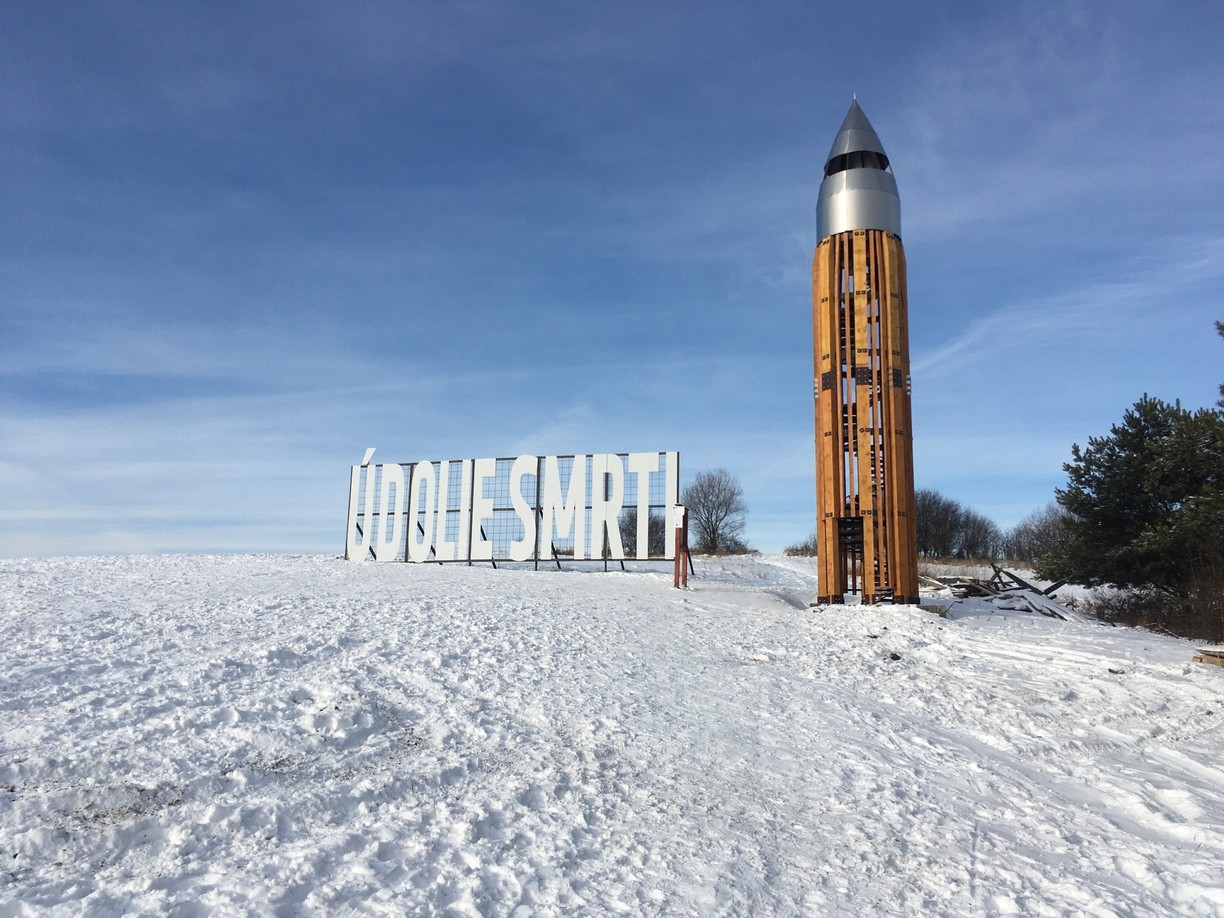
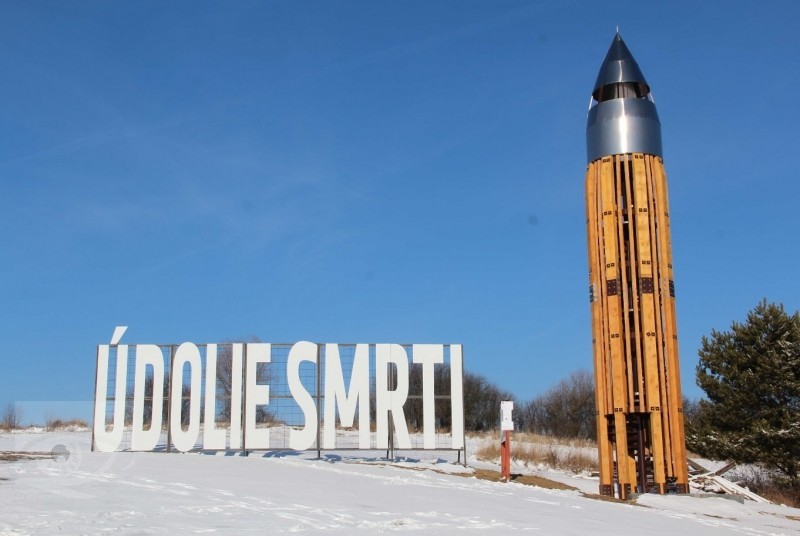
At the end of November 2021, a unique lookout tower made of metal and wood, 13.65 metres high, with 4 floors and a shape reminiscent of the cartridge for the Czechoslovak rifle VZ. 24, was completed in Kružlová, in the Valley of Death. The cost of the construction of the lookout tower was 24,000 euros. The Prešov Self-Administration Region contributed EUR 9 000. The tower provides magnificent views of the surroundings, almost the entire Death Valley, the surrounding villages, part of Svidník and, in case of favourable weather, the High Tatras are visible from the tower. Entrance is free all year round.
"The lookout tower has an unusual shape of a military hub to symbolize the memory of the fiercest battles during the war, which took place on the territory of the Dukla Pass. We will try to enter this unique lookout tower into the Book of Slovak Records, because there is nothing like it in Slovakia. The lookout tower should attract more tourists," said Adrián Gužo, mayor of Kružlová.
The active village of Kružlová makes itself visible
The village of Kružlová already has two Slovak records - for the largest vertical sign of the VALLEY OF DEATH and the largest heart for collecting PET lids. The Slovak record for the largest vertical HOLE OF DEATH sign was registered on 11 April 2019. The 998x290 cm sign is a photogenic landmark and tourist attraction and is reminiscent of the world-famous HOLLYWOOD sign. In 2021, the municipality of Kružlová also issued the first souvenir 0 euro collector's note Dukla - Valley of Death.
The village of Kružlová is only 8 km from Svidník and 43 km from Bardejov and has 709 inhabitants. It is especially famous for the Valley of Death, where heavy fighting took place during the liberation of Slovakia during World War II. To this day, the fighting here is reminiscent of the tanks deployed on the ground. In recent years, the village of Kružlová has made itself visible on the tourism map with several achievements that have created the potential for multiplying tourism in its area from about 20,000 visitors a year to several times that number.
Death Valley is gradually being modernised, the municipality has restored the paintwork of the tanks with the help of a financial contribution from the Ministry of Defence of the Slovak Republic and is always trying to offer something new to the tourists. The concrete igloos - tank barrier were restored, the parking lot was asphalted, a toilet-latrine was installed, a new tower was built in place of the old one, there is a possibility of sleeping in the night shelter, and a mobile shop selling souvenirs, snacks and other things related to Death Valley operates in season.
Death Valley
The Death Valley is situated between the villages of Kružlová, Kapišová, and Nižná Písaná, where tank equipment depicting a tank company under attack is deployed in the terrain. In the cadastre of the village of Kružlová it is symbolized by 8 T-34/85 tanks, which are lined up in the firing line. Visitors are reminded of the tank battles that took place in this area from 25 to 27 October 1944. The most interesting for visitors is the staged ramming of a Soviet T-34/85 tank wedged into a German PZKpfw.IVAusf.J tank at the fork in the road to Death Valley. This valley, where the heaviest battles took place with massive deployment of tanks, belongs to the Dukla Museum.

Dukla attracts with its military history
In the region around Svidník there are many war monuments. One of the biggest landmarks - the Observation Tower at Dukla (the catastre of the village Vyšný Komárnik) is currently closed to the public, but other attractions, including the permanent exhibition "Military History of Slovakia 1914 - 1945" in the Military Museum in Svidník, are open to the public. The northeast of Slovakia thus offers an interesting variety of cultural events, some of them with a tradition dating back to the Middle Ages.
For fans of war history, the main season begins on 1 May, when the Military History Museum, Svidník Museum Department, opens various attractions located in the field after the winter. Visitors can admire the battlefield, touch tanks and other heavy combat equipment from World War II deployed in the grounds of the Natural History Museum and around the road to Svidník. The area of the Dukla Pass and its surroundings was the scene of bloody battles in the autumn and winter of 1944 between Red Army units, units of the 1st Czechoslovak Army Corps in the USSR and units of the German Wehrmacht.

The Czechoslovak Army Memorial at Dukla is a national cultural monument. This natural area is one of the most visited places in the region. Over 60 thousand Soviet and Czechoslovak soldiers were killed during the fighting. The 28 m high memorial was erected in 1949. It is embedded in the military cemetery, which is crossed by a colonnade with bronze plaques. The plaques bear the names of 1 265 fallen members of the 1st Čsl. Army Corps.
The chapter of war history is also documented by the year-round Military Museum in Svidník. It is housed in a building shaped like an anti-tank mine. In the park near the museum there is an external exhibition of heavy military equipment. The Soviet Army Memorial, where more than 9,000 soldiers killed in the autumn of 1944 are buried, has stood adjacent to the exposition since 1954.

The Slovak National Museum - Museum of Ukrainian Culture is located directly in the town. It includes an open-air museum of folk architecture with a rare wooden temple and the Dezider Milly Gallery, which is dominated by a set of icons that are among the oldest items in the museum's collection. In the category of national cultural monuments there are eleven wooden churches of the Eastern rite in the vicinity of Svidník.
In summer, the attractive Festival of Culture of the Rusyn-Ukrainians of Slovakia and the Rusyn Festival are held here. The dominant feature of the centre of Svidník is the statue of army general Ludvík Svoboda, the only one in Central Europe. The surroundings provide opportunities for exploring folk customs and customs, hiking along marked trails, camping, cycling, and car tourism. In Svidník there is a water world Aquaruthenia Svidník with indoor pools and wellness with year-round operation.
Source:OOCR Šariš Bardejov