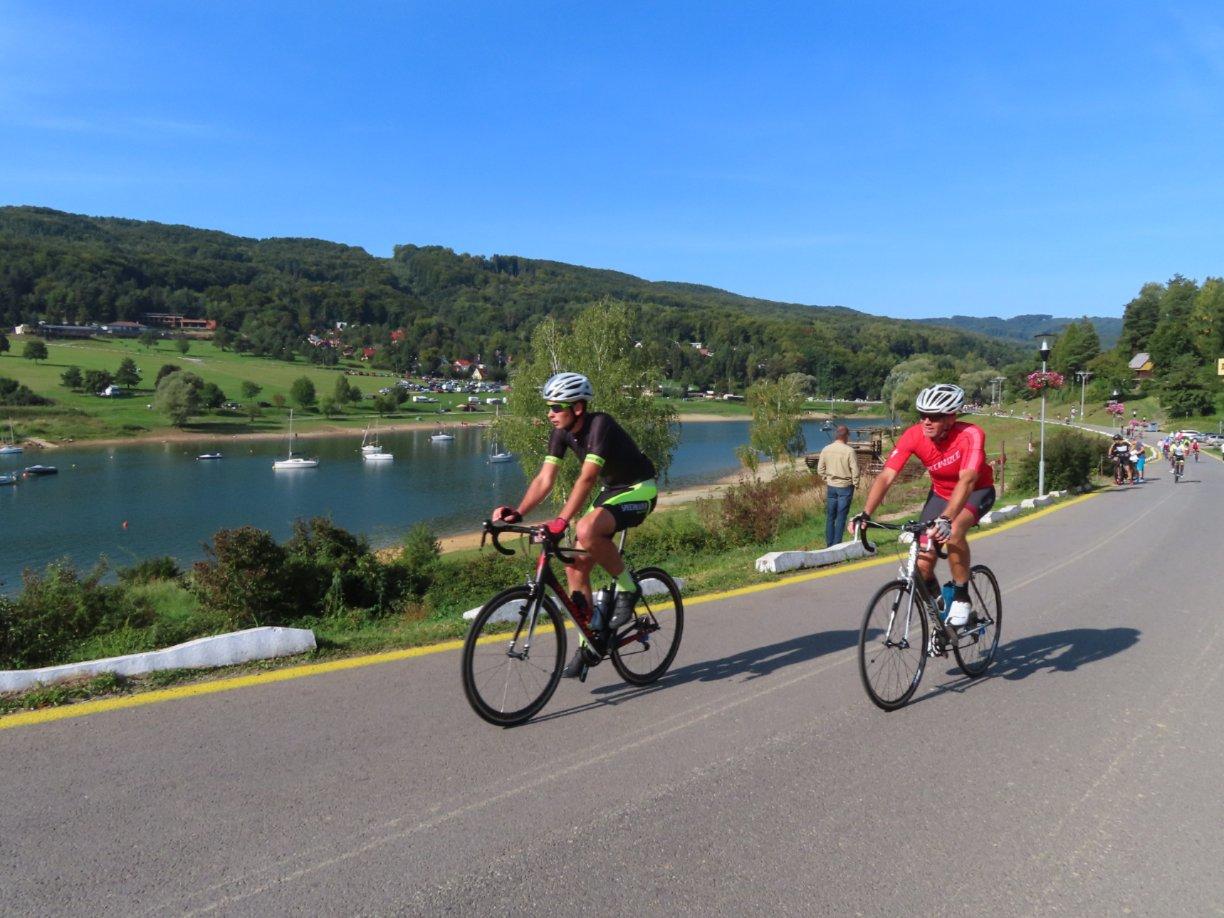


When cycling, we are less likely to notice coloured markings and not know exactly what they mean. In doing so, they can help us plan our route, choose the right kind of bike, and help us navigate the terrain during the ride. The painted "C" (C) belongs to the basic elements of bicycle markings which are placed on a fixed device, an object in the terrain. The direction and the kilometre distance to the destination is determined by a cycle marker and a cycle sign placed on the cycle posts (cycle markers).
The Slovak Cycling Club (SCK) is responsible for marking the routes for cyclists. The organisation brings together people interested in cycling and its aim is to build a network of marked cycling routes. It has been operating since 1994 and has a nationwide scope. Together with other markers they developed a unified system of marking cycling routes in Slovakia, which led to the development of STN 01 8028.

Coloured markings of cycling routes: red, blue, green, yellow or black.
Red colour - exclusively Eurovelo routes (network of European cycle routes) and long-distance cycle routes, which run through several countries, regions or districts, the most interesting places, the easiness of the routes, crossing river valleys, mountain passes, length (30 - 80 km), the possibility of accommodation and catering on the route.
Blue colour - parallel cycling routes to long-distance cycling routes, longer cycling routes off cycling routes, or more demanding cycling routes off cycling routes, length (40-50 km), at least one source of accommodation and catering.
Green colour - medium and easy cycling routes, health and family routes, length (20 - 30 km), the source of accommodation should be located at least at the starting or finishing point of the cycling route.
Yellow colour - light cycling routes and connections between cycling routes or short detours to various natural, historical and technical points of interest, length (1-15 km), may not meet the requirement for accommodation and catering facilities.
Black colour - it marks easy educational cycling routes.
By road surface we can choose cycling routes on road or mountain.
Road cycling routes are used by all types of bicycles (road, trekking, mountain). They are usually on asphalt or paved roads. They use the national network of classes II and III, asphalt special-purpose roads, often on asphalt embankments. In the pictogram symbolism of cycle lanes, the cyclist's logo in the colour of the respective route is used for large and small cycle lanes.
Mountain biking trails (MTB) are usually only passable on mountain bikes (exceptionally on trekking bikes). They are mostly on macadam, forest and dirt roads with a natural surface. The rule of thumb here is that some of the more difficult ones are often impassable or impassable after rain. In the pictogram symbolism of cycle paths, the cyclist's logo in the colour of the respective route, supported by a triangle, is used for both large and small cycle paths. Such a pictogram essentially represents 'uphill riding'.

Difficulty of cycling routes (in terms of physical fitness) is divided into 3 groups:
- REKREA (light) - there are less demanding cycling routes and circuits for getting acquainted with cycling. They require the basics of cycling technique and a basic physical fund.
- SPORT (medium) - are more demanding sports circuits or cycling routes, which require a slight mastery of cycling technique and good physical condition.
- EXPERT (heavy) - are challenging cycling routes and circuits for cyclists who devote enough time to this hobby. They must have a very good cycling technique and very good fitness. Routes of this nature are mostly on natural paths in a mountain environment, designed for MTB.
Planning the route, choosing the right bike contributes in its own way to a safe and comfortable ride. It is important to respect the rules of the road and ultimately choose a route taking into account your abilities and capabilities.
Author. Marianna Jenčíková, Department of Strategic Development, Regional Development Department, PSK Office