

Greek Catholic Bishop's Palace began to write its history with the conversion of the building of the town hospital and poorhouse into a new monastery (it was the second one in the town along with the Franciscan one), which was acquired by the Minorites in 1671. After the arrival of Imrich Tököli's anti-Habsburg rebel troops in 1682, the Minorites were forced to abandon their seat. They returned to it in 1686.
In 1698 they started to build a new building for their monastery, at the Lower Town Gate, on the site where four smaller craftsmen's houses had previously been located. The activity of the Minorites in Prešov was terminated by the decree of Emperor Joseph II of 12 July 1787, by which the monastery was dissolved, in spite of the pleas of the town magistrate and the Bishop of Jäger to the monarch himself.
Shortly after the departure of the last monks (1788), a great fire broke out in Prešov, which also engulfed the building of the dissolved Minorite monastery. Its repair was already provided by the city, which placed the repaired building in the a permanent military garrison.
In 1791, the seat of the Greek-Catholic vicariate was moved from Košice to Prešov to the premises of the former Minorite monastery. The vicar Michal Bradáč came to Prešov.
On 22 September 1818, Pope Pius VII issued the bull Relata semper, establishing the Greek Catholic Bishopric in Prešov. The whole complex of the former monastery was then in 1821 assigned to the first bishop of the newly established Presov Greek Catholic diocese, Gregor Tarkovič (1754 - 1841). At that time, the gradual renovation of the complex and the adaptation of the newly established bishop's residence began.
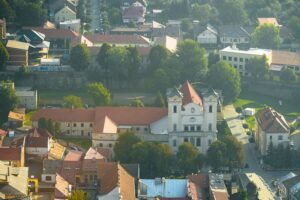
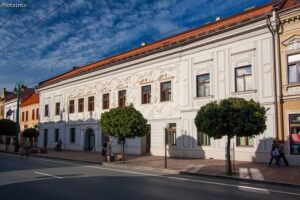
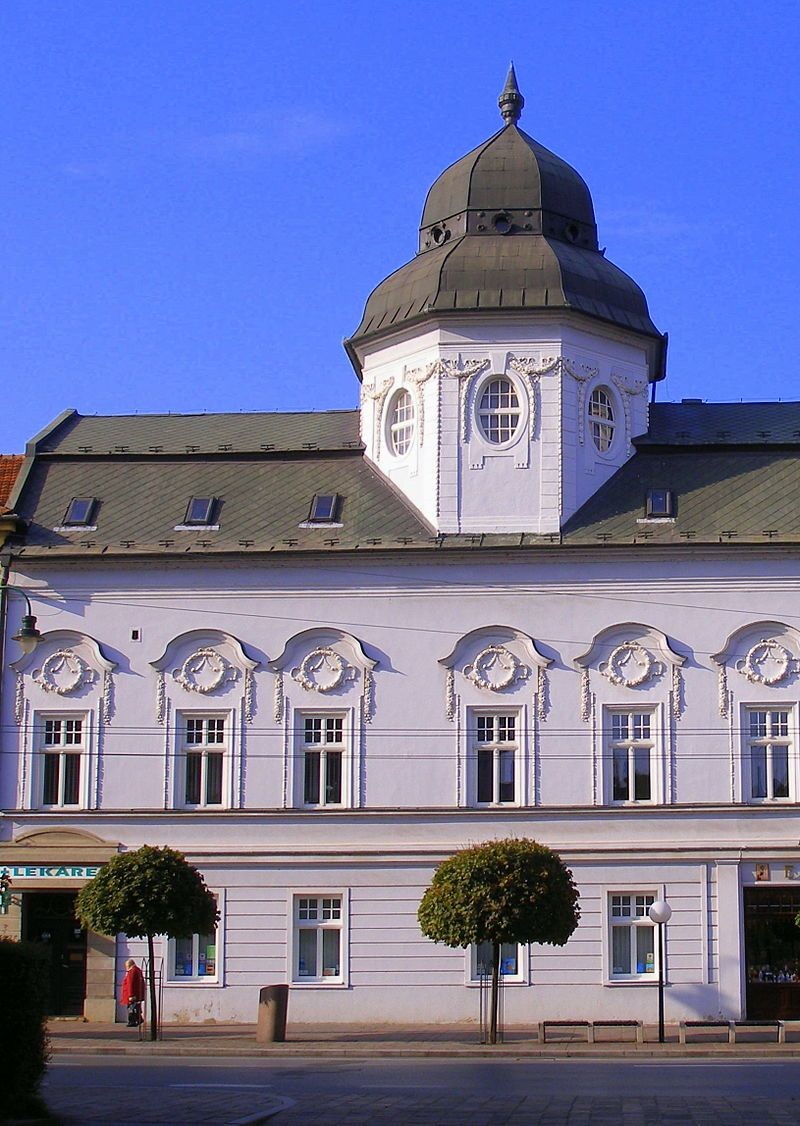
Jozef Gaganec, the second bishop of Prešov, had the extensive redevelopment of the settlement, where today's two-storey palace building with a classicist façade was built. A large triangular gable (tympanum) was placed above the main entrance. A large dome dominated the central part of the building.
The bishop's palace was together with the temple damaged 20 December 1944 during the bombing Prešov by Soviet aircraft. The reconstruction of both buildings began immediately after the end of the war. In 1950, when the Greek Catholic Church in Czechoslovakia was abolished by the decision of the highest state authorities, both buildings - the church and the bishop's palace - became the property of the Orthodox Church. The Bishop's Palace thus became the seat of the Orthodox Archbishop of Presov for 4 decades. Since 1990 it has been the seat of the Bishop of the Greek Catholic Church in Slovakia and the Czech Republic.
The Greek-Catholic Episcopal Palace is currently the seat of the Archbishop of Presov and the highest representative of the Greek-Catholic Church in Slovakia - Archbishop and Metropolitan Vladyka Jan Babjak, SJ.
Source: Švorc, P.: Guide to Historical Prešov. Universum. 2006. Prešov. ISBN 80-89046-35-5.; www.presov.sk
Cover photo: Wikipedia - by Doko Ing. Mgr. Jozef Kotulič - Own work, CC BY-SA 3.0, https://lnk.sk/E012