

The Polish town of Dukla is located approximately 17 km from the Dukla Pass, which forms the border between Slovakia and Poland.
Dukla was founded on the so-called Hungarian Route, which was used to import wine to Poland. The first written references to Dukla date back to 1366, but 14 years later it was granted town rights. The town was fortified until the 18th century, as it survived several raids. The development of Dukla was mainly due to the Mniszch family, who tried to turn it into an important cultural and political centre. The older bastion building was converted into a representative palace with a park.
A visit to the city offers many cultural and historical attractions. Among the most important are the parish church complex of St. Mary Magdalene, the monastery complex of the Bernardine Fathers, the palace-park complex of Mniszechow and several other architectural and urbanistic jewels.

Monastery Church of St. John of Dukla
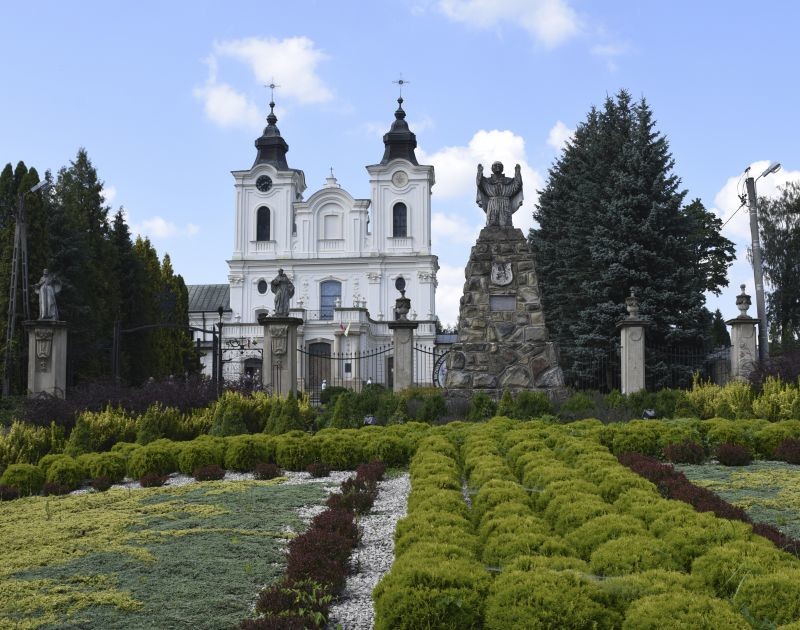
The stone statue of Our Lady Immaculately Conceived is located in the square in front of the Church of St. John of Dukla, who lived as a hermit in the nearby hills of Cergowa and Zaśpit. It was because of him that Pope John Paul II visited the town ten years ago. In front of the parish church there is a statue of the saint himself from his youth. The idea of building a pilgrimage church in the family town of the future Saint appeared after his beatification in 1733. The present church was built between 1761 and 1764 as a late baroque basilica.
Historical Museum in Dukla
The historic palace and park complex from the second half of the 18th century, which houses the historical museum, is the most impressive building in Dukla. Over the centuries, this building has undergone three phases of thorough renovation that have changed its shape, style and size. The palace was once the centre of cultural, social and political life in Poland. Although the building was destroyed and the furnishings dismantled as a result of the Second World War, the complex retains its historical and artistic values and is one of the most valuable monuments of Polish national culture. The museum features direct exhibitions on the history of Dukla, the Dukla Palace-Park complex and the battles in the Carpathian Mountains during World War I and World War II. Several thematic exhibitions are organised here every year. In the courtyard there is an open-air museum of heavy armour.